When you buy through links on our articles, Future and its syndication partners may earn a commission.

For the first time in more than 50 years, humans are cruising through lunar space.
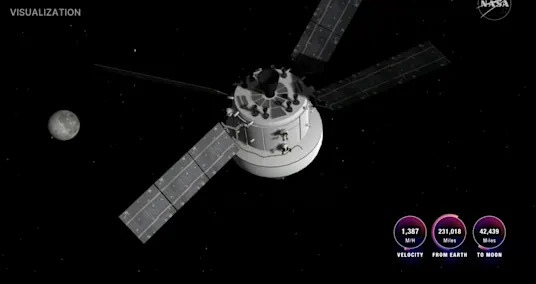
The four astronauts of NASA's Artemis 2 mission arrived in the moon's sphere of influence — the region where lunar gravity exerts a more powerful pull than that of Earth — today (April 6) at 12:37 a.m. EDT (0437 GMT).
The milestone occurred when the mission's Orion capsule was about 39,000 miles (62,764 kilometers) from the moon and roughly 232,000 miles (373,368 km) from Earth, a commentator said during NASA's Artemis 2 livestream.
The Artemis 2 astronauts — NASA's Reid Wiseman, Victor Glover and Christina Koch and the Canadian Space Agency's Jeremy Hansen — are the first people to cross the lunar threshold since December 1972, when the three-person Apollo 17 moon-landing mission did so.
Artemis 2 will not touch down on the moon, or even enter lunar orbit. Rather, Orion will loop around the moon's far side this evening in a history-making flyby. During that encounter, Artemis 2 will get farther from Earth than any crewed flight ever has.
The distance record is currently held by the Apollo 13 astronauts, who got 248,655 miles (400,171 km) from our planet in April 1970. At the height of tonight's flyby, just after 7 p.m. EDT (2300 GMT), Artemis 2 will be 252,757 miles (406,773 km) away from the rest of humanity, NASA officials have said.
The Artemis 2 astronauts will study the moon during the flyby, gathering data that could help scientists better understand the terrain and geology of Earth's nearest neighbor. They'll also be treated to a total solar eclipse, which will not be visible to those of us here on terra firma.
In addition, the flyby will chart their path home: Lunar gravity will slingshot Orion back toward Earth. Artemis 2 astronauts will come home on Friday (April 10), ending their 10-day mission with a parachute-aided splashdown off the coast of San Diego.
Editor's note: This story was updated at 1:15 a.m. EDT on April 6 with NASA's revised time of Orion's entry into the moon's sphere of influence — 12:37 a.m. EDT rather than 12:41 a.m. EDT.
LATEST POSTS
- 1
 France bans Muslim gathering citing risk to participants
 - 2IndiGo lands IATA chief Willie Walsh as new CEO
- 3Figure out How to Amplify Innovation and Infotainment Frameworks for Senior Drivers in SUVs
- 4Former hostage Eitan Mor on Hamas: ‘They will not give up until the last Israeli is gone'
- 5Figure out How to Recognize the Right Areas for 5G Pinnacles\





- Amazon sued over 'punitive' handling of employee absences
- Commonsense Ways to work on Your Funds with a Restricted Pay
- Which sandwich do you find totally delectable? !
- Benin coup thwarted by loyalist troops, president tells nation
- Pick Your Favored method of transportation
- Display of Netanyahu's severed head 'incites public to murder PM', Likud says in official complaint
- Artemis II astronauts find hidden Easter eggs as they close in on the moon
- Comet C/2025 K1 (ATLAS) breaks apart in incredible telescope photos
- Astronomers detect rare 'free floating' exoplanet 10,000 light-years from Earth