NEW YORK (AP) — Using the oldest dog genes studied so far, scientists are finding more evidence that our furry friends have been our companions for thousands of years.
Scientists think dogs descended from an ancient population of gray wolves somewhere in Europe or Asia. Tens of thousands of years ago, those wolves got used to living with people and became less aggressive. As they became domesticated, their genes shifted along with their behavior, giving rise to the pups we know today.
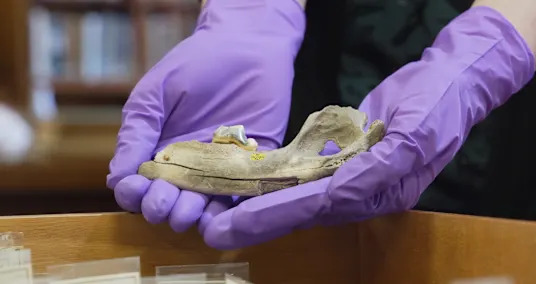
But exactly when and where this happened remains a mystery. Scientists are studying bits of DNA found in ancient dog and wolf remains to figure out what the earliest dogs may have looked like and where they came from.
In two separate studies published Wednesday in the journal Nature, researchers pushed the timeline back. They established a new way to study ancient canine DNA — which is often contaminated and tough to extract — by isolating just the doggy bits.
They examined ancient genes from the remains of over 200 dogs and wolves. The oldest dated back to about 15,800 years ago, moving the origin of dogs back by at least 5,000 years.
“This unique relationship between people and dogs has existed for such a long time and is continuing on today,” said University of Michigan dog genomics expert Jeffrey Kidd, who was not involved with the new research.
The genes showed that dogs were already spread out across Western Europe and Asia 14,200 years ago, at a time before agriculture and farming. These dogs lived with hunter-gatherer humans who were constantly on the move.
The dawn of agriculture — a major shift in human history — brought new people to Europe from southwest Asia. They mixed and mingled with Europeans, leaving a lasting and varied imprint on their genes.
But the dog genes studied by the scientists, stretching from the United Kingdom all the way to Turkey, stayed more consistent. They were less impacted by the arrival of new humans during the development of agriculture, and more by interactions between different hunter-gatherer groups and their dogs thousands of years before.
That's different from dogs in Asia and the Americas, whose genes more closely reflect the movement patterns of their owners.
Scientists don't know exactly what the first dogs looked like, but they have some ideas.
“We're suspecting they would have resembled smaller wolves,” said study co-author Lachie Scarsbrook with the Ludwig Maximilian University of Munich.
It's also not clear how these ancient dogs lived alongside their humans. They could have stood guard or helped them hunt, but probably also played with young children.
There's still more work to go to pinpoint exactly when dogs emerged — the first few pages of a storied relationship that's still going strong.
“They are humanity's best friend, alongside our societies for the last 16,000 years and will continue to in the future,” Scarsbrook said.
___
The Associated Press Health and Science Department receives support from the Howard Hughes Medical Institute’s Department of Science Education and the Robert Wood Johnson Foundation. The AP is solely responsible for all content.
LATEST POSTS
- 1
 The capacity to understand people on a profound level: Exploring Life's Intricacies
 - 2At least 7 dead as Israel renews attacks on Beirut and across Lebanon
- 3Federal judge upholds Hawaii's new climate change tax on cruise passengers
- 4How much would you pay to meet a Real Housewife? At BravoCon, the limit does not exist.
- 5Alix Earle built trust by sharing her acne woes. Now her skin care line is raising questions.





- Embrace the Outside: Exercises and Entertainment
- New movies to watch this week: See 'Marty Supreme' in theaters, rent 'Springsteen: Deliver Me from Nowhere,' stream 'Cover-Up' on Netflix
- China's 1st reusable rocket explodes in dramatic fireball during landing after reaching orbit on debut flight
- A definitive Bike Standoff: Decision in favor of Your Number one Ride
- Step by step instructions to Explore Assessment Ramifications of Disc Rates
- ‘And then we saw the little head.’ Scientists witness rare sperm whale birth
- Image of foreigners being arrested in S.Africa during Eid is AI-generated
- The Best Web-based Courses for Expertise Improvement
- One dead, six wounded in various crime-related shootings in Israel over the weekend