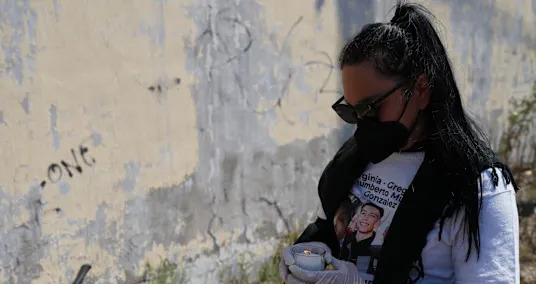
MEXICO CITY (AP) — Mexico's government said in a new report on Friday that it has identified signs of life for a third of the country's 130,000 registered missing people, an announcement that was quickly criticized by a number of search groups which called it an attempt to undermine the depth of Mexico’s disappearance crisis.
The government said that by cross-referencing things like vaccination records, birth and marriage registries and tax filings, officials found that 40,367 people — around 31% of reported disappearances — showed some activity in government records since they'd been reported missing.
Marcela Figueroa, a top security official, said that it indicated that those people might still be alive.
Using that search method, and consulting with a number of search groups, she said that the government was able to track down 5,269 people and mark them as "found."
Figueroa described many of those cases as “voluntary absences,” citing a number of examples of men leaving their partners for another woman being reported as missing and women running away from abusive relationships.
“Not all disappearances are the same,” she said, adding that the government was constantly working to locate Mexico's missing people.
Criticism of the report
But Héctor Flores, a leader of a search collective in the heart of Mexico’s disappearance crisis, the state of Jalisco, said that he saw the Friday report as “misleading” and said the government’s methodology lacked transparency.
Groups like his have accused the government for years of trying to disappear the disappeared to save face on an international stage. Historic impunity in such cases has fueled distrust among families who believe that changes to the registry could cut real cases from the list and hinder search efforts.
“For us, it’s just another attempt by the administration to hide and downplay the numbers and continue to paint a picture that doesn’t reflect the reality of what we’re living through,” said Flores, whose 19-year-old son was forcibly disappeared by agents from the Jalisco state prosecutor’s office in 2021.
According to figures shared Friday, 46,000, or 36%, of those registered as disappeared had missing data like names and dates that made searches impossible.
Meanwhile, 43,128, or 33%, showed no registered activities in government databases. Of those, less than 10% are under criminal investigation, something Figueroa called a failure by Mexican authorities.
Figueroa also said that the government was more vigorously “monitoring” local prosecutor's offices that have failed to investigate and accurately document cases of missing people, and has sought to boost the number of cases being investigated.
“Society and the families can trust in the records and better tools to search for people,” Figueroa said.
Fierce argument over the disappeared
The reinterpreted figures are part of a larger effort to bring order to a convoluted dataset that connects to a collective trauma scarring the Latin American nation, and cuts to the heart of a fierce argument over how Mexico tracks its disappearance crisis.
Forcibly disappearing people has long been a tactic by cartels to consolidate control through terror while also concealing homicide numbers. The 130,000 people registered as missing since 2006 is enough to fill a small city and the faces of missing people on fliers line the streets of Mexico's biggest cities.
The controversy stretches back years, but festered under ex-President Andrés Manuel López Obrador, who was in office from 2018-2024. His government launched a census of the disappeared after claiming that the figures had been inflated to make him look bad.
A cascade of criticisms in 2023 led to the resignation of the official leading the search for the disappeared.
Mexico's government has said that the official registry of disappeared is an overcount, often marred by faulty data from local prosecutor's offices and cases of people being reported missing two or three times.
Search groups like Flores' and the U.N. Committee on Enforced Disappearances have argued that the real number is likely higher than the official stats because of failures by local governments, fear by some families to report missing cases and a lack of “clear and transparent" data.
The human rights group Miguel Agustín Pro Juárez Human Rights Center on Friday said in a statement that while it welcomed efforts to make the data more reliable, the way officials framed the data “minimizes the state’s responsibility” in the disappearance crisis and does little to aid families who often have to take justice into their own hands and search for their missing loved ones themselves.
LATEST POSTS
- 1
 A mom's viral post is raising the question: Do kids need snacks? Dietitians have answers.
 - 2What to know about King Charles III's cancer treatment and his message to the public
- 3Tech Patterns: Contraptions That Will Shape What's in store
- 4Kate Hudson, 46, says she doesn't need long workouts to feel good
- 5Most loved Web-based feature: Which Stage Do You Like


- Brazil judge orders government to add JBS subsidiary to 'dirty list' for slavery
- Japan deploys the military to counter a surge in bear attacks
- Why ordering takeout or calling the dog walker might lead to a happier relationship
- Steinmeier honours Italian 'guest workers' who rebuilt German economy
- Triple polar vortex to plunge central and eastern U.S. into Arctic cold through mid-December
- Gaza amputees struggle to rebuild lives as the enclave faces shortages of prosthetic limbs
- Czech Republic's new premier: No money for Ukraine
- 'I was diagnosed with incurable brain cancer on holiday'
- Four countries to boycott Eurovision 2026 over Israel’s inclusion